Posted in Operation ORCHID

Op. Orchid: Using What You’ve Got

When we say that not all hope is lost, it isn’t out of chronic optimism. There are cases of historic houses and structures being scrupulously salvaged and freshened up in far worse conditions than what is illustrated through the Duke Estate. In fact, there are pieces of the past that, although they go without any substantial camaraderie, have been included in today’s management of this magnificent property. Additionally, there are abundant opportunities for the current trustees and executives to capitalize on their historic significance with. In a burst of positivity, we at the RRBlog have decided to shed light on what’s still lingering like a ghost of decades bygone and what chances at preservation have not yet passed us by.

Let’s start our journey with one of the oldest structures on the property, whose identity was recently rediscovered to the public with the opening of the mansion’s acres: The Boathouse. While there has been some dialogue about having this structure house public restrooms, there’s much to do with this project piece. From a generalist perspective, this boathouse is perhaps the most at-risk for flooding and likely has years of prior damages from mold and stormy seasons following 1993. Due to it having the lowest elevation of any building on the property in conjunction with its being in closest proximity to the Raritan River on the northern border, this structure can probably pass for next year’s Top 10 Most Endangered at this rate! Preservation NJ already is observing the treatment that Duke Farm’s executives handle the Trumbauer-Abele Greenhouse since 2017’s nomination was finalized. The boathouse, much like anything else on the estate, boasts a unique design that features the thematic motif of the landscape, the boulder style foundation, with some Victorian roof ornaments and wood siding. There is an excellent view of two sets of east-facing double doors to Boathouse Lake from the vantage point above. I’m not sure public restrooms would serve this building true justice. Perhaps there’s more merit in using Boathouse Lake (currently scented of rancid, rotting fish or the like) to teach outdoorsy folk about sustainable and environmentally-responsible water activities, like how to kayak with the welfare of the environment in mind.

Another stop on our tour of hopefuls is the Visitor’s Lodge. For those of you who fondly remember the Greenhouses on display (1961-2008), you probably also remember a low-slung Dutch-esque building with a magnificent stone fireplace inside. This building, perching the western edge of the greenhouses’ esplanade, was the check-in point for all incoming tourists to the gardens. The Visitor’s Lodge housed a variety of seasonal goodies, office spaces, archival materials, and even a residence at one point. Today it stands frequently empty with the exception of the visitor with a full bladder or a rare conference for the executives. In our most recent travel to the property, this building was under extravagant interior remodeling. What was once a room full to the brim with files and shelving, desks and paperwork is now covered generously in plastic tarp and a scaffold. We can only hope that this becomes a restorative initiative that welcomes the public to enjoy the warmth of a hearth and seating in a room intended for guests year-round. This particular development is interesting because it makes us at the RRBlog curious about what this spells out for the near future of the greenhouses since these two structures back in Duke days worked together for guests to embrace the area.

With the observant eye of a former employee, we did get a chance to highlight what elements of the property are, in fact, being reused. Perhaps most obvious to him was the thatched siding of the Orchid Range, which turned out to be none other than the same siding used in the Colonial American Garden display from the larger structure. Additional materials removed from the larger Trumbauer-Abele structure included benches from the Italian garden, a mirror from the Chinese garden, two magnificent statues from the Italian garden (now incorporated into the Hay Barn exposed to the raw elements and again in the orchid display), and even structural landscape elements were identified as being original to the greenhouses! Despite the high merits of reusing and recycling these priceless pieces, there remains little to no information or publicity generated from the Farms about these practices.
Posted in The Publications

Manny’s mod shope; Better bass tone for under $30!

The fender bass is a classic instrument, since its debut in the early 50’s it has been used in nearly every style of bass playing, and every genre of music. Vintage fender basses now cost upwards of $5000 , on the low end of the spectrum, sometimes less, but classic era basses cost the remortgaging of a home.

I myself would love to have capacities to afford such luxuries, but in the absence of such funds I found a great way to upgrade my Mexican made p bass, the Wilkinson 4 saddle bass bridge!

My p bass is an early Mexican made one from 1992, the neck is a more j bass profile, and it has shaller tuners which are solid, and these had a thin layer of finish on the neck which feels very nice. The bridge has always been ok and reliable on it, but it seemed to be a chrome, or nickel plated brass. The Wilkinson bridge has larger unplated brass saddles and upon installation and first playing it feels and sounds livelier and louder. These are marketed as a classic style bridge and it is very accurate.

Posted in Operation ORCHID, The Publications, The Trials of Doris

Op. Orchid: Bringing Down The House

Upon walking through the towering gates, the newly opened site formerly containing Doris Duke’s home, the winding path let to the remnants of Ms. Duke’s home, some stone steps and what could be summarized as an otherwise mostly vacant field. Walking up the path revealed some stone fixtures; the leftover parcels of the structure of the Duke Mansion in Hillsborough NJ. Even with snow decorating them they reflected a grace, age, and majesty that these stone fixtures had led to before the adamant efforts of the Duke Farms Foundation and the Doris Duke Charitable Foundation to demolish the beloved home of their founder. These organizations were claiming a decade of research into alternative uses for the home was made, bringing no documentation or proof of these efforts, only providing a powerpoint made by someone hired by the foundation, to trials determining the house’s fate.

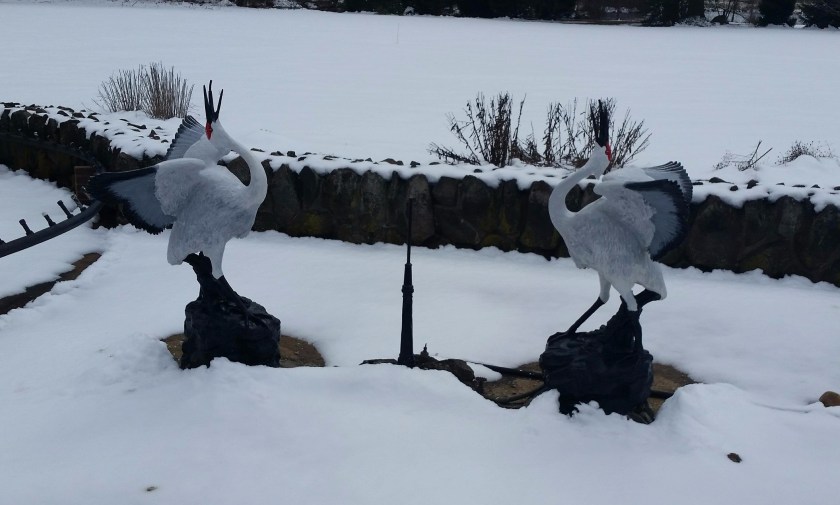
Walking up the stairs I couldn’t help but tell my wonderful companion that maybe we should try to knock where the doors would have been, just in case. You could likely guess that there was no invisible Duke Mansion there, but there is an entire field with some circular fountain beds with freshly painted birds in the middle of the fountains, while looking new not in any way matching the patina of the rest of the property.  In the case of the Garden of Nations remainder, there’s too much patina, wood rot, and gaps in the outer integrity of the structure. Oh the irony.

I could be quoted saying “You know what would be really nice here? A HOUSE!”. Walking around the grounds previously occupied by the home of Doris Duke, there was a somber feeling in my chest as if the nearly vacant space was reflective of the hole I felt in my chest. It feels as if I’m visiting the grave of someone whom I had been trying to save, but couldn’t be saved because of the slow train coming that had no intention of stopping with this person in the way of the tracks they have laid. On a gentle slope going away from the plain at the center of the location, there is a bit of a grotto, a pleasant small body of water that I could imagine was a peaceful and serene spot for Ms. Duke when her home was on the grounds of her estate.

Most upsetting for me is the gall of all parties involved in the previous and concurrent attempts at assassination of the Duke family history and the legacy of Doris Duke. A plaque on the site of Doris Duke’s home reads (in reference to this site) “Doris Duke’s seasonal residence”, an improvement to DFF’s use of the phrase “Former main residence” (when referring to the two story hole in the ground as the main residence). Upon this plaque are images of other homes that Duke would visit when she wasn’t in her home and main residence in Hillsborough NJ (the one that’s not a large hole in the ground). Below these images are the words to the effect of; Doris Duke left specific instructions for her other properties, Shangra La, and Rough Point. This is the boldest of the falsehoods shared by DFF in their failure to honor their founder’s mission and purpose for founding the DFF and DDCF. According to Christie’s Auction, “it was Duke Farms she truly considered ‘home’ “.

It is important to note that during proceedings in attempts to preserve the Duke mansion the DFF had the copy of the will of Doris Duke submitted into evidence struck from the record. In the will, that they fail to correctly reference on the plaque commemorating the demolished home of their founder, it states that she expects her organizations to maintain and preserve all of her properties, stating the term “preservation” and other words to that effect several times while there is a single demolition clause much later in the will which is not quite specific either, clearly Duke had hoped her foundations would honor her legacy.


Posted in Operation ORCHID

Op. Orchid: Embracing Old Scars

I had the distinct pleasure of beginning a photography initiative at the Duke Estate alongside wonderful people this week. In an effort to spread awareness of the management of historic properties in America and what it takes to save them- one timeless place at a time.

As a very brief background, the USA is one of a very small number of countries in the modernized world that still treats its historic buildings and homes like outdated garbage. In other established countries like France, England, Belize, and Japan, the demolition of historic or contributing historic/antiquated properties is far less frequent in comparison. Why is this?

America prides itself partly on being bigger, more modernized, and improved- which means cleaning up ‘blemishes’ or ‘unsightly’ reminders that we participated in less-sophisticated times. It’s a silly thing, really. We do the same thing with scars by putting all kinds of expensive creams on them to make them go away- to erase any physical reminders that we experienced something in the past. Why does it all have relevance to Duke’s Estate? It appears as though they have attempted to put vanishing cream of their own on several of the artifacts from this week’s voyages.

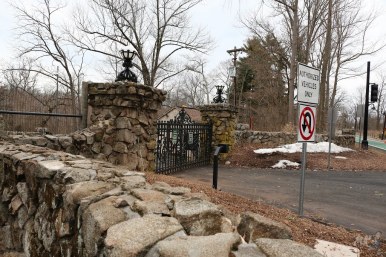
Let’s take for instance (1) the heron statues at the site of the mansion, (2) the original south gate gatehouse being completely revised and (3) the rusty original iron gates that now sit behind the coach barn. It seems like new and not-comperable changes are considered ‘necessary modifications’. While they are well-intended, these particularly strike the RRBlog staff as short-changing the historic integrity of this magnificent property. Author’s note: the featured banner image in this post also includes

28945638_1579379605516463_763666027_o.jpg
The twin herons are actually part of a much larger structure- a double circle fountain- that once flanked a beautiful glass-paned room of Duke Mansion. For the greater part of the recorded local history, these herons were colored green with a naturally-occuring patina of sorts. In propaganda photos for the demolition (2015-2016), these herons are noted for their wingless nature- but even then- they were aqua green like the Statue of Liberty. Today, they stand restored, wings clearly attached, but repainted to resemble real herons but somehow standing out against the rest of the property’s natural aging. While it’s not the worst thing by far, it’s clearly not blended with the property’s flow.

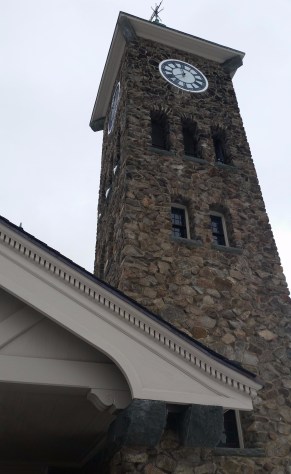
gatesThe south gate gatehouse is actually news to me, despite it making perfect sense. Likely in attempt to accommodate larger numbers of guests for 2012’s restructuring, the original gate house at this location was taken out in exchange for a pedestrian gate to supplement its wider automatic counterpart. Once again, I have to ask what was so wrong with what was there before. …Probably nothing, but restoration is a scarce commodity.
28928140_1579379625516461_1136426925_o.jpgFinally I was particularly disturbed when I sought refuge in the women’s restroom behind the coach barn. When I went up the stairs, something made me turn to the right, where my eyes locked on a bright orange rust color. It wasn’t just the color, but the shape that made me stop paying attention to my needs. Within a small fenced-in area, a set of beautifully-crafted gates leaned sideways in a lonesome, tired fashion. There was something familiar about them, although no one in my walking party could place them. From the thorough rust, it was only evident that they were definitely original to the estate. Once again, this begs the question of why, when a nonprofit is as financially loaded as Duke’s, doesn’t it spend the money on restoring these and reusing them to maintain originality and design? If we slowly replace or redesign the elements that make a property unique, we will be left with no original fabric of it’s intricately-woven tapestry of landscape features and components.
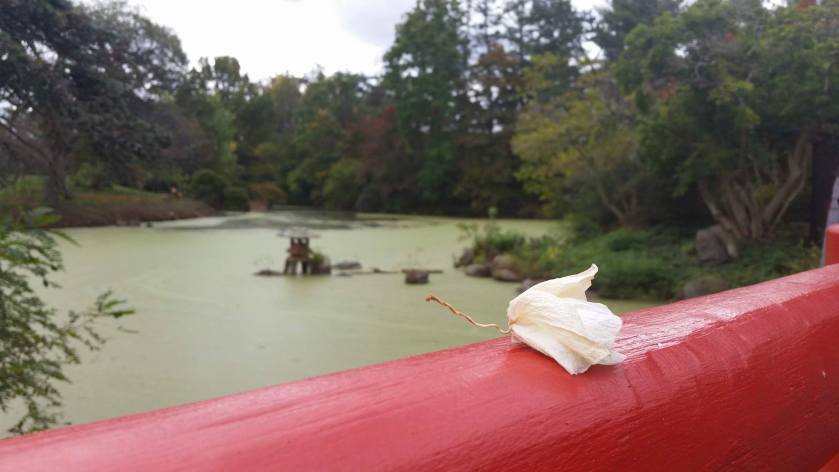
What is the real point of using these vanishing cream method if it is such a compromise of individuality? Arguably, this is one of the methods of historic ‘preservation’ that simply isn’t preservation, it’s modernist replacement.

Posted in Manny's Music Column, The Publications

Swingin’ it with Dandy Wellington

This guy is the real deal when it comes to the authentic Jazz experience. Dandy Wellington takes New York’s jazz scene by storm- arguably, he exponentially grows it. The Retro Revival had a fantastic opportunity to get to know Dandy as an artist and up-and-coming revivalist recently through his majestique Facebook page: Dandy on Facebook.

What I think really does it for us at RRBlog is Dandy’s commitment to his role as a jazz band leader and an authentic image of the 30s and 40s, which was the height of jazz music and its culture. Adorned with formal hats, well-pressed suits and remarkable swingin’ moves in his performances, Dandy’s ability to convey the Jazz Age is second to none. Perhaps in the likeness and image of icons like Cab Calloway, Charlie ‘Bird’ Parker, and of course, Duke Ellington, Dandy’s style is one that captivates the class in all his audience members.

According to his most undated biography page, Dandy hails from Harlem, one of history’s epicenters of culture, particularly noted for African American music, jazz, and the Harlem Renaissance. What makes Dandy so successful against the grain of an increasingly-streamlined lifetyle is “the classic aesthetic and modern perspective that is Dandy, has, and will continue to be a fixture of NYC and beyond” (http://www.dandywellington.com/about.html).

If you are a fan of Jazz, its modern comtemporaries, or the good old classics like Duke Ellington, Dandy is a sure-to-please performer with the right attitude toward his craft. His events are available via: http://band.dandywellington.com/dandy-live

Posted in Operation ORCHID

Operation ORCHID: Footnote #98

Recently the world has been made a smaller place for those in the grassroots. Despite the challenges and road block-esque situation that we face in attempting to preserve a legacy here in South Somerville, there has been resonance across our allies. Most recently, Philanthropy Daily’s writer, Martin Morse Wooster published his latest work titled, How Great Philanthropists Failed & How you Can Succeed at Protecting Your Legacy. We do not find it ironic or coincidental that this book has been published after Wooster’s input was given to the tragic case of the Duke Mansion’s demolition, which began its trials in Summer 2015. His article from March 31st, 2016 sheds a clear light on his position toward the proprietors of the estate as he asks in rhetoric, “How do you honor your founder’s memory by tearing down her house? That’s a question the Doris Duke Charitable Foundation has to answer.” Wooster continues his monologue to include what can be learned from Duke Farms’ shameful example citing that, “the case of Doris Duke’s house reminds donors to put all restrictions in writing. ” (Wooster, 2016).

The answer to his rhetoric is simple. Tearing down the childhood home and countryside endeavor of the benefactors of Duke Farms is not any appropriate way of honoring the Dukes themselves. If anything, it translates to a rude, shameless ‘screw you’. The mission statement of Duke Farms can arguably have been lost in translation as well. Anyone can observe its modifications since established around 2003.

Fast forward to January 16th, 2018: Wooster takes to the press again in a small press run of his most recent book. In its pages he cites articulately how the Doris Duke Charitable Foundation has succeeded in failing its benefactors. He cites DORIS and how the public attempted to remedy the issues that plague the foundation through their attack on Duke Mansion. He even honors The Duchess of South Somerville, a memoir collection and brief history of Duke’s recent past in footnote 98.

Despite the narrow outreach that ORCHID currently has, the message is heard loud and clear across a spectrum of different audiences: the removal of Duke Mansion and the systemic neglect across the property is not acceptable.

So let’s get educated and share in the historic revolution that has begun to erupt in New Jersey. For purchasing information on either piece of literature, please visit the following links:
Click Here for Martin Wooster’s Book

Click Here for The Duchess Book

Posted in The Publications

Courtship; a study in the history of romance

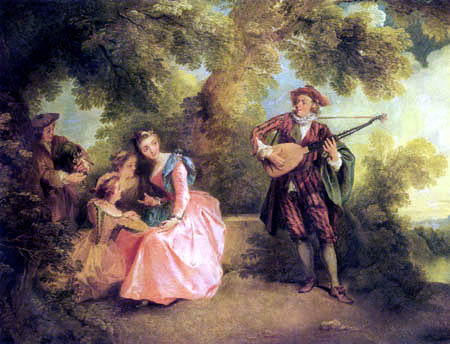
wpid-the_serenade_by_nicolas_lancret.jpg

I went to university from the years of 2009 till 2014, and throughout that entire experience “romantic relationships” seemed to form very sporadically among my acquaintances. The phenomenon known as “hooking up” always struck me as foreign, at least from my own understanding. A visceral desire to be intimate with someone without having gotten to know that person strikes me as a very strange approach to interpersonal relationships. From what I was able to observe, hook ups can happen at a party where conversations are near impossible to hold because of blaring music or absurd amounts of inebriation, which leads me to believe that its driven by something visceral. Weather by pure physical attraction, influence of alcohol, or some combination of the two I could otherwise not understand this occurrence (though I do not judge). These hookups may lead to an emotionally bonded relationship, and can even flourish into a strong long-term relationship, but this style of initiating a relationship has never appealed to me personally.

Another situation I have seen arise is the friendship (for a short period) into hookup relationship, also known as the path of no return. Not to say that this sort of start to a physically intimate relationship cannot be successful in certain cases, but there are complications that could easily arise that challenge the friendship aspect especially in situations where either party engages in further hooking up and or lack communicative skills. This is something we see happen in the romantic comedy de jour, and has some similarities to the kind of relationship that is an ideal for many of my closest friends and myself personally, friendship into courtship.

My first ever relationship began when I had realized hat I felt a particular void in my emotional state for the previous few days, what had brought this about? A female friend of mine had been away for a few days, and I genuinely (as genuinely as is possible for a teenager) missed them. This drove me to communicate with her how I felt about her absence, and that was the start of a courtship, that began with getting to know them in a non-sexualized, personality and interest focused relationship. In my limited understanding of relationships I found this kind of relationship, and thusly courtship (in the sense of spending months, or years getting to know someone before the suggestion of romance) was particularly powerful, and most importantly meaningful. This seems to me an under appreciated, and timeless style of relationship.

Ultimately relationships and how they come to be is up to the actors of the relationship, modern relationships can be very successful, but I believe that there are lessons to be learned from traditional values in nurturing and growing a long lasting and loving relationship.

*Historically courtships began as buissnes arrangements, which is an important element of any relationship because especially in the modern age both members of a couple normally have to maintain a full time job to support an average household, and an imbalance in that aspect of a relationship can cause turbulince for any couple (unless one of the members of a pairing are wealthy  and prefer their mate not work, in which case a power imbalance may occur).
Chivalry is another element of courtship that I feel is under appriciated, *”From buying a woman dinner to opening a door for her, many of today’s courting rituals are rooted in medieval chivalry”, as a stark contrast to modern relationships, “Chastity and honor were highly regarded virtues”. This is not to say modern sexuality and romantic ideas don’t have their own logic, but this is a highly underrated aspect of relationships, the phase of courtship that is about knowing tour partner as an individual and not in a sexualized way(life expectancies are much longer than the Medieval era). Entering the victorian era romance became essential to marriage as an institution; “She would notify the lucky gentleman by giving him her own card requesting that he escort her home. Almost all courting took place in the girl’s home, always under the eye of watchful parents. If the courting progressed, the couple might advance to the front porch.”

After my observations, and some research I have come to a consensus of sorts, courtship has changed over time, and I feel as if  each period teaches us a lesson about love, and how to raise a family, what elements can be, and ought to be utilized to lay the foundation to a long lasting relationship, and to hopefully leave behind a legacy of love and harmony for the next generation. There is an over emphasis in the modern approach to courtship on the physical aspects of love and not enough exploration into emotional aspects of relationships. While both are important elements to any relationships it has always been my personal feeling that the emotional and intellectual connection in a relationship always precedes the physical elements, not taking importance away from the physical elements of a relationship, but should be sought and nurtured first and foremost.

http://genealogy.about.com/cs/timelines/a/romance_history.htm

Posted in Revival Style Guide

Revival Style: Giving Snoods a Second Chance

It is no secret that Harpie Lyn never liked snoods. Nothing screams ‘bombshell’ to me quite like an alternative-fabric hair net. Can you taste the sarcasm yet? In every effort to stay classy, I was very dismissive toward the idea of a hair snood. This month, it was time to challenge my own predetermined assumptions of the dreaded snood. “Snood”…What an odd word. It sticks to my tongue like a rogue piece of yarn in a frenzy of knitting.

The first stage of snoodwearing was denial. This isn’t a hairpiece. It’s not an accessory. It’s just a beanie worn awkwardly at some sophisticated angle. I refused it. The second stage was experimentation. If it’s knit by me, it can be taken apart by me if it’s dreadful. Maybe that’s a fair trade. So there’s a resolution if I wore the snood and thought it was the worst thing since Herbert Hoover’s economy. I ended up knitting a generic snood of snuggly brown yarn. The third stage of snood was knitting it and dumbfoundedly becoming attached to it.

I started wearing my snood around the house in an attempt to build some sense of confidence in my latest mushroom-esque addition. Eventually I realized that even while banging away at my keyboard (completely sedentary activity, mind you), the stupid thing would slip off my tiny head. Flustered, I tried stringing it with an elastic piece. It looked even worse. Giving up, I resorted to those little snap-clips that every little girl uses to keep her bangs out of her eyes. With one on each side by my ears, the snood finally stayed put. Then I realized that the reason a snood wasn’t prudent for me all this time was because it isn’t a simple garment, despite its appearance. Topvintage.net (which has quickly become one of my favorite sites on the internet) had several illustrations of snoods and how to wear them- 100% of the time, the models had their hair rolled and done up. Here lies my problem. So I began rolling my hair before wearing the snood using a hair tie and one oversized bobby pin that matched the color of my [natural] hair. I wore it out the first time to run errands (what a conservative lady stereotype) and got no feedback, which I interpreted as a good thing. So I wore it again. In the brittle misery of this particularly frigid winter, my little snood experiment did well to fit into my own style and appeal to women who don’t want to wear hats but also don’t want to have a bare noggin to the temperatures.

Let’s talk history: Recollections Blog (another excellent new resource) posted this snapshot of snoods emerging in the Middle Ages: Click Here. In the earlier part of the 20th century, snoods seemed to re-emerge as a means of function before style, and shortly becoming a staple of both. WeHeartVintage.co also illustrated excellently what different forms the modernized snood took. Click Here.

The snood, in many ways, shapes up to be something between a fascinator piece and a hat; one that is perfect for both indoors and outside in the cooler-but-not-frozen months. Aesthetically, once the positioning of the -er- headpiece is correct, the snood is rather complimentary. Particularly with a warm coat or sweater, the snood adds a certain 1930s-40s vintage look to any woman’s apparel. Despite my previous mentions of the nonsensical nogginwear, I must admit that through experimenting, my mind has been changed (if only for the season) about snoods.

Posted in Revival Style Guide

Revial Style: The Victorian Details (Winter 2018)

This year in winter, it seems like there has been a slight shift in seasonal affects. Usually when a therapist says this, they’re talking about seasonal depression, but thankfully, this time it’s a better case. Just in time for the ushering in of a new year, everyone seems to have committed to having a better time than in its predecessor year, 2017.

2018 is bound to be a year of practicality, artistry, embracing of uniquenesses, and a more open forum and expression of the retro liveliness in us all. That sense of nostalgia and warmth is exactly the type of method we have immediately adopted to survive these icy conditions. Whereas we usually have a focus on the midcentury, postwar trends that swept the Americas in the 20th century, this winter has forced us to pull all the stops from Pre- WW2 era aesthetics and potent Victorian vamp to stay toasty.

It is an excellent start to the New Retro of 2018 in that it brings us back to the ornate, highly-handcrafted, and often practical means of Victorian times with some modern twists. We found it unintentional yet interesting that the foreshadowing of the RRBlog’s Revival Style column on Clozy Coats from each decade that we published last year. This year, the desire to make layers sophsticated and elegant comes from a need rather than an adornment. Here in New Jersey, we have experienced nearly two weeks of profound cold weather; some of our nights have reached temperatures of -20 (F). As of right now, our climate rivals that of Alaska and the northern regions of Canada. The farmer’s almanac is one source we live by through its unique analysis through 250+ years of meteorological trend-tracking. In the retro spirit, to our dismay, this winter is anticipated to be one frosty, freezing experience. Thank heavens for the old-world references that are finding their way back to our culture- these revived notions may save you some frostbite!

Faux fur lined coats, thermal long socks, thick boots, heavy gloves and elaborate hats of knitted materials or weatherproof felts all have become commonplace following the crippling cold temperatures of Times Square on New Year’s Eve. It isn’t strange to see a businesswoman sporting a 3/4 or full length coat this winter. The gents have readopted work-appropriate boots and thick wool socks, shamelessly including warm (faux) fur hats, leather thermal gloves, and even hefty scarves to add to their woolen vests and suits tailored for these extreme temperatures.

Ladies, don’t even think about wearing your Sunday best heels out in this. What I think is the very best about the slight Victorian revival is how well it fits itself into wintertime. We found these puppies at Modcloth (Click Here) that epitomize the shapes of Victorian style footwear without the potential cracked ankles of high heels. Worried about the transition from slim jackets and puffy winter coats to hefty vintage counterparts? Fall in love with one of these darling demures and surely, your mind will be changed. After all, darlings, life is an occasion- we all can dress for it as we like: Click for Victorian Style Winter Gear, or perhaps you prefer the earlier years of the 20th century as your go-to for garb: Click for Era Themed Ensembles!

Gents, you have it a little easier- many of your well-loved name carriers already stock most of what you need to get your retro on this season. For instance, Macy’s carries a plethora of simple, timeless wool silhouettes for any dapper fellow to challenge the snow with. To no surprise of ours at the Retro Revival, men’s boots have found a middle ground between timeless and sophisticated, masculine yet elegant, & formal yet functional in our marketplace. DSW nailed this one: Men’s Warm Winter Footwear.

As the snow spends another few days before melting down in Jersey, we will be learning more about how to heat the home and hearth with a Victorian twist that is sure to keep everyone thawed through this intense winter ahead. Cheers, Darlings!

Posted in Manny's Music Column

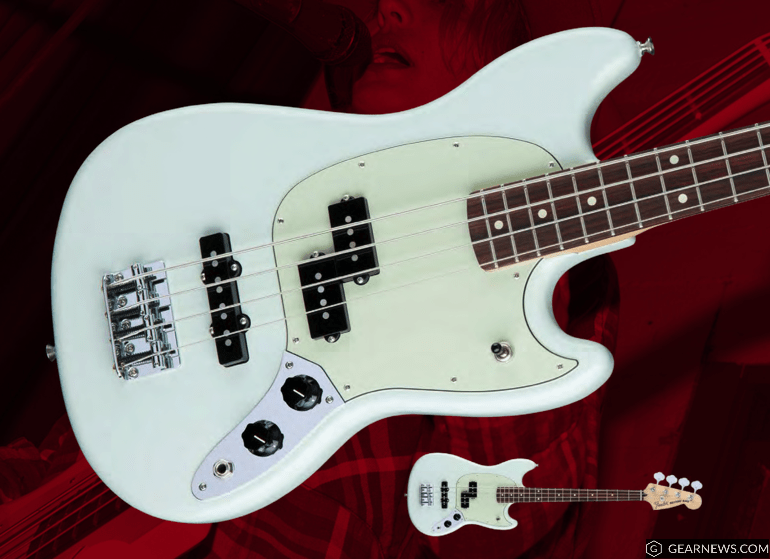
Fender Mustang vs. Squier Bronco, short scale bass shootout. 

Recently I picked up a Squier Bronco Bass from The Guitar Boutique in Ridgefield New Jersey. So in a bit of an experiment to see what a modded mid-price Mexican made short scale Bass by Fender sounds like in comparison to a stock Indonesian made Squier Bass. Not a scientific comparison, but simply what extra money into a mid-price instrument versus the stock version of an Eastern made import instrument by the same parent company sound like. 
The current configuration on my Fender Mustang bass is Seymour Duncan PJ quarter pound pickup set, stock tuners, stock bridge, with short scale rotosound flatwound strings.

In comparison the Squier Bronco bass has all stock everything, strings possibly being stock as well.