Posted in The Publications

Women’s Empowerment and Hilda

https://www.vintag.es/2016/03/50-sexy-vintage-illustrations-of-hilda.html?m=1

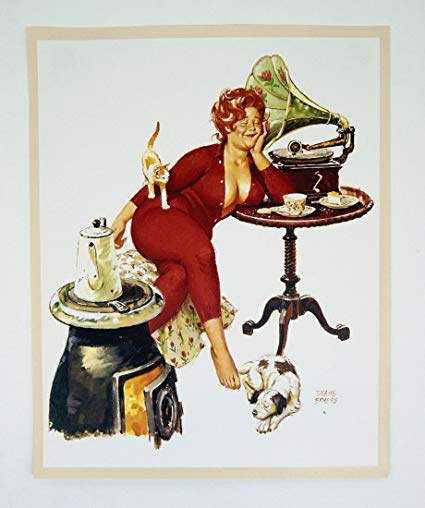
Everyone who has any stigmatized image of the 1940s-50s probably knows what a pin-up model is. Slender, proportionate women in playful or scandalous positions and stylish (although sparse) outfits would pose for a picture which would be later changed into a painted artist’s rendition that would often be more colorful and eye-catching. This all sounds good and to-be-expected for the era. But this post isn’t about the models we expected. This post is focused on a brave woman named Hilda, who was the only plus-size pin-up model of that time.

I found the article for the first time through Facebook links, and my introduction to Hilda was harmless at first. She was featured in her first photo as a nude model whose only coverings were woven flowers, with a pursed expression and an outdoorsy theme.

Co-author’s notes; Hilda is an intreaguing figure among women in the modelling industry, especially in the 40’s and 50’s. She can within reason be seen as among the first plus sized models, though models of the era were bordering on the cusp of what we would today suggest at plus sized as well. Beauty standards of the era were still based upon a less realistic ideal , with hourglass body shape being a standard to some extent, atleast the hour glass was allowed to have some volume. This is not to say that modern campaigns focused on “real women” aren’t having an effect, but rather that it would seem that other body types are also being lauded as beautiful and socially and culturally desirable.

Hilda can unfortunately be considered to be part of the body positivity movement which has valid points in its acknowledgement of diversity of body types and acceptable forms of beauty, has in the more extreme aspects of that movement can encourage unhealthy and concerning effects. The issue of public health and wellness is essential to understanding the overall impact of shifting ideologies especially in the beauty world.

While not a fan of body augmentation personally, I still conceed that if someone is happier with themselves after having gotten breast or buttox augmentation as is the current trend, it can have a private and personal health result. Improved self image and perception can be immensely valuable in ones level of confidence and perceotion of their social standing and can have positive impact on their overall well-being. But the surge of these operations, and further manipulation of the human form poses a social and public health challenge, when people are having ribs removed, and having themselves turned in literal “human barbie dolls” this is the extreme limit of these once helpful procedures.

I would be concerned that while Hilda is a revolutionary figure (pun intended) for her era in the industry she was involved in, to hyper idealize any exaggerated figure can glamorize the immaciated or over indulged sets concerning prescidents and sets potentially unhealthy and unmaintainable expectations. These expectations can stem from either extreme of female physical representation. This is where I humbly have to take the stance of simply not being wise enough or interested enough in being right in a matter that I am too young to have experienced, how does this portrayal of women with the era of it’s publishing, and modern perspective leave you feeling on the matter, dear readers?

Please leave your respectful and insightful comments below, and as always, stay curious.

Posted in The Publications

A weekend with some Good Caramel pt. 1

On memorial day weekend I had gone up to record with Brenyama for our second studio album, the location we would be spending our long weekend at is none other than Good Caramel Records, a studio housed in an old Catholic school in downtown Buffalo. 

Entering the studio facility was refreshing for me as someone who has a halfway decent home studio, which satiated my creative needs still. from the kitchenette which wraps around to the sole restroom on the ground floor, to the makeshift bass amp room under the stairs every facet of this setup amazed me. The elements of improvisation at work everywhere I could see, using every square inch of space to full effect.

Further exploring the space leads one to go upstairs to studio A, a wooden dome of space and sound, our work space for the weekend. What occurred over the next 3 days was magic, getting roughly 90% of tracking done with some pretty good first vocal takes too. The sounds recorded there on our record sound so organic and also professional which is a refreshing combination.  I was so fortunate to be able to use the bass head and cab favored by Robbie of the Goo Goo Dolls, a vintage Ampeg SVT with an 8×10 cab. Mics used for my bass was a blend of the audix d6 and the Electro Voice RE20. My Ronaldo Custom P bass seems to be the only bass recorded on the record. Using a legitimate Hammond organ only adds to the good vibes and sound here. 
I’m sure I will write more regarding this weekend, stay tuned for part 2!

Posted in Operation ORCHID

Operation Orchid: A Tale of Two Townships

Irony is a manifestation of fate tangled within itself. Are things always coincidental, or is everything fueled by an antecedent and the prospect of a consequence? It’s a psychologically rooted question; one that we find ourselves stuck with often these days when observing the stark contrast of behaviors between historic preservation in the locality of the Duke Estate and its counterparts. Okay, let’s cut the abstract and get nitty gritty.

So on July 16th, all the information has to be submitted to Somerset County by the public regarding the preservation of historic parcels and eras of interest. This gives the members of this county FOUR DAYS from now to have this info submitted.

https://www.co.somerset.nj.us/government/public-works/planning/current-projects

What’s ironic here is that there is a specific category for the emerging of ‘Great Estates’ like Dukes and Natirar, (1880-1911) which seeks general input. This county was the same one that, in preventative measures in 2015, turned a blind eye to the desperation of the DORIS group in trying to preserve the integrity of the Duke Estate through saving the mansion. In addition, this is the same county whose court rejected the measures taken to appeal the demolition permit granted by Hillsborough Township. But I mean hey, the judge that presided the case is a sibling of someone who works directly for the Doris Duke Charitable Foundation so obviously dialogues off the record played a huge role in getting us to this point right?

Now that the estate is missing the house that literally defines the title ‘estate’ at Duke Farms, it seems like Somerset County is either getting wise or getting profoundly remorseful. But hindsight is always 20/20. You can’t bring back what you destroyed. This is how we whitewash history and skew the stories of the past. The timeline is perpetually damaged unless some serious preservation efforts and commemorative methods are prepared ASAP.

MEANWHILE…..

Mount Laurel is getting it together!

https://www.courierpostonline.com/story/news/local/south-jersey/2018/06/15/historic-mount-laurel-house-hooton-road-scheduled-demolished/692223002/

Unlike the case of the Duke Mansion, Mount Laurel identifies with the same costly concerns, but collected the support of PNJ (Preservation New Jersey) who was able to acquire a temporary halt to the demolition in advance of it beginning- with the stipulation that the township would review and submit a plan for the space. The clock is ticking, no doubt, but the fight is always on against these staples of American culture- which if no one noticed- is lacking serious emphasis. The gentrification between technology and culture is staggering, one that deserves the attention first through using what you’ve already got- including old houses that requiresome degree of remediation.

Ah, life’s little ironies indeed. The story continues for ORCHID and the real legacy of Doris Duke. Get it together, New Jersey!

Do you have input? SEND IT IN: PreservationPlan@co.somerset.nj.us

Posted in The Publications

The MidCentury Housewife: The Self-Made Vocational Genius

* We apologize for the delay*

The iconic midcentury housewife has one final quality that has allowed her to stand the test of time, making the collective her truly a classic, timeless, Americana sweetheart. Back in the days of the War, women were entrusted to participate effectively in the workforce in what could be considered one of the most profound shifts in gender roles since the Industrial Revolution. From this shift in roles, women started to expand on their vocational palettes from housework to machinery, textiles, recycling, and other war-effort manufacturing that ultimately is considered one of the strengths America had in winning WW2.

The rapid increase in the workforce by de-jure allowing women to work alongside men (or really, in lieu of able-bodied men who were otherwise drafted at the time) gave a collectivist approach to American living. This attitude that ‘we’re all in this together’ lasted through the wartime and dissolved slightly into the middle of the century, but the know-how and skill sets were not lost. So those young women who advocated for the country in the 40s grew older, married, and brought unique tinkering abilities to the next generation of American homes. Riviters, manufacturers, and other material processors became wives capable of fixing their children’s toys before dad got home, maintaining home improvement like painting projects and wallpapering jobs, and shared their skills (in addition to the classics like sewing and cooking) with their children.

I regret to say that most of that thriftiness has since faded over time, but it is one of the many revivalist attributes of that midcentury can-do spirit. We look forward to a new generation of thrifty, independent thinkers to emerge, although perhaps in different circumstances, to make a new era of empowered, poised, and unbreakable female spirits.

Posted in Revival Style Guide, The Publications

The MidCentury Housewife: As an Influence on Good Housekeeping

We at the RRBlog identify strongly with the assumption that media has a reciprocal relationship with society. For instance, if a movie comes out that exhibits strong messages of equality, it is both spreading that message but also appealing to the social movement already in place. Similarly, if a new style is spreading, it is likely that a modern movie will incorporate it.  With this in mind, the midcentury icon of a sparkling, smiling housewife was such the icon likely because of the media explosion that surrounded these women.

So let’s take a look at it through the lens of ‘Good Housekeeping’: The majority of stylistic elements of homemaking, aesthetics, and the overall notion of a woman leading the home with a matriarchal status all get a facelift in the 50s. With hubby out being a good little breadwinner, the wife had carte blanche to create the image of a modern home within the family’s means. Much like we mentioned in previous miniseries articles, things tended to become competitive. If Doreen had a showstopping new ensemble from the Danish postmodern collection, then it was likely that Charlotte living 3 doors down would be considering a redecoration of her own to showcase.

What I think also helped make these little dreams a reality were the installation of communities of ‘little boxes’ like those of Levittowns across the eastern portion of the USA. With financial incentives in place for recently-veteran’d men returning from the war, feasibility for homeownership was at an all-time high for this population (which was quite a percentage of the overall population). The iconic wives had a place to call home and raise children. In many ways, this accessibility alone provided for pop culture to latch onto the ‘American Dream’ being lived out by so many folks in similar circumstances.

So about this Good Housekeeping? Pop culture (especially the visual arts) depicted having a happy home as an accomplishment for these wives. I think, in many ways, that if means allow, many homeowners have the same bidirectional influence on good housekeeping and the media today. Thousands of remodels, keeping up with the Joneses, and publicity stunts that lower the costs associated with updated home features all contribute to finding the most pleasing look for homes across the world. With new trends like tiny house living, antique revivalism, and even the slow decline of gigantic houses, there is a broader variety of ‘trends’ and styles to fit the aesthetics of the home. Although the matriarchy no longer rules the roost in that stereotypical way, the pride associated with personalizing the home is more interconnected with media than ever with the implements of sites like Houzz, Overstock, and especially Pinterest.

So in many ways, the high aesthetics, low cost of living, and high emphasis on imagery of the midcentury is what happened to give the housewives of this era the ultimate say in how the home was structured.

Posted in Revival Style Guide, The Publications

The MidCentury Housewife: A Style Sophisticate

As many of you have guessed from the pop art image we’ve been using to share these posts, it’s pretty clear that midcentury housewives had a killer sense of style on top of everything else they did. These women, despite the constant attention being drawn to keep a home and raise the children, found time to put on the ritz. Apron included, these model maidens managed to make themselves look like the perfection they sought after. Whether it was taking that extra few minutes to make hairpin curls happen or ensure that her skirt fell just below her knees, attention to details made their era of class a memorable one.

Why did they go through all the extra trouble, though? Didn’t these women have some of the highest levels of social and familial pressures and obligations?

It makes it challenging to believe they had any time to themselves. But the one thing that gave some time to the tireless midcentury mama is that they weren’t obligated to be breadwinners. With an adjusted tax rate on the rich with far less withholding for the middle class, in conjunction with a higher valued dollar (USD) at the time, one parent working was enough to support the family. It helps also that internet, TV, and cell data fees weren’t in the budget back then. So with dad out at work, mom was left with the housework and shopping, but also with a fair share of her own time. It may not be much, but it was just enough for the midcentury housewife to treat herself to the little joys like sewing herself something that makes her feel beautiful, visiting the salon, or kicking back with her favorite tea and books. After all, the kids didn’t get back until 3:00pm.

There were several additional reasons that the spare time of a midcentury housewife was often spent beautifying herself. First was social norms: America had adopted a very collectivist means of propaganda to support the country in World War II. This meant that women were included in the passive aggressive tactic of modeling excellence in aesthetic and efficiency during a time where production was crucial to win the war efforts. From the 40s, the collectivist approach cadenced into a lingering sense of contribution toward the greater good of America. One clean, neat, and lively wife meant that the image she produced was setting a higher standard and represented the country well. (And so, in several media-encrusted situations, competition between the ladies in this era erupted…)

Another such reason for the wives of the midcentury looking so impeccable was their desire to maintain a sense of sophistication meshed with youth. Many instances arose at the time ‘Astronaut Wives’ was first published that the cover art wasn’t beliveably the actual wives- but this fact was debunked as readers became culturally aware of the variation in styles from that time period. In fact, youthly looks (like form-fitting clothing and ratted hairstyles) were often reserved for teenagers, while women in their twenties through forties had a distinct uniqueness to their getup. Preserving that image, (flared skirts, high-heeled shoes, organized colors and few patterns, and modest blouses), meant that the housewife was capable with ease to uphold her status and do so with grace.

It makes us wonder how this new generation of wives will set the standards for themselves, no? Stay Curious!

Posted in Revival Style Guide, The Publications

The MidCentury Housewife: Memorable Motherhood (A Mother’s Day Special)

Another extraordinary component we would like to explore about the midcentury wives is their experiences as (often young) mothers. Despite the considerable lack of real health research that supported the notions that butter is awful for arteries, tetra-chlorides in clothing detergents are a terrible ingredient, and that spanking children in public is actually humiliating as opposed to effective; these women did all they could to produce a breed of childhood that remains the nostalgic reverie of tens of thousands of baby boomers today.

What was it that made this golden age of childhood so memorable? The answer to that question, no matter what year, decade, or century it is, will always be: Mom.

There are several components of timeless maternal methods that started in the middle of the 20th century. Strongly-encouraged outside play, independence, a gentle touch, and a firm teaching of what is earned versus what is given all mesh to create the image of the midcentury mom. These may seem like the very basics, but without the adornments of materialism and modern luxuries, but these are what make moms so memorable.

Take for instance one classic situation; the children are instructed to go outside to play after their homework is finished- there would only be the rule to be home in time for dinner or before the streetlights went on (whichever came first). Unless the rain is falling, mom made sure they would at least spend time out of the house to prepare dinner. Once dinner was made, mom in her apron and the children with their hardy appetites would convene, talk over a warm meal and discuss the day. Should one of the little ones refuse to finish dinner, that’s all that would be offered through the next day’s breakfast. A balanced diet was ensured. But at the end of the day, though her rules were unbreakable, her kids could always count on mom to attend to each of them, tucking the children into bed, one by one.

Always available to offer advice, hem pants too long or skirts too short, stitch up a favorite teddy bear, or cook warm soup during winter’s unforgivable season of sore throats: moms had to have it all to offer. It wasn’t a competition per se, but becoming a masterful mama meant that she could be counted on again for future generations and for friends and neighbors. Eager to share understanding and warmth, midcentury motherhood was no exception to the housewife’s ultimate desire to achieve excellence in her role, no matter how many roles she played.

Moms make the best memories. Period. This Mother’s Day, we salute all our reader-moms and readers’ moms for their timeless and truly unconditional sharing of love.

Posted in Revival Style Guide, The Publications

The Midcentury Housewife: Pursuit of Perfection

While we simmered through the last post regarding the Midcentury housewife, this month, we decided to discuss the housewife as an icon of distinction and eloquence through her pursuit of perfection. How does mother dear make the perfect gelatin casserole every time for her guests to enoy? How does she keep the pleats of her skirt so sharp? The truth is, a housewife of the middle of the 20th century had to juggle at least a dozen roles to keep her household a powerful, pristine representation of excellence. Most of these multiple roles are identical to those of today’s mothers, except that 70 years ago, many modern amenities like microwaves and dryers were only just becoming affordable commodities. Clothes lines, handmade dinners, and manually-steamed clothing were all the responsibility of the household matriarch.

When someone creates anything handmade, there is a strong sense of unmatched pride that comes with its production. So, in order to truly impress, the housewives took explicit care of their individual capital, making each napkin folded crisply and ensuring the stitches of their children’s dress clothes were tight and neat. If guests were to arrive, the children would be on their best behavior, the table would be set, and a formal homemade meal would be executed. Back in mid- 20th Century America, despite the somewhat rampant materialism associated with this mentality, the worth of a household was often assumed by the visual appearance and aesthetic of the family and their output. (At least, this was the perception of mainstream pop culture)

The housewife was responsible for creating this aesthetic for whatever guest or company the home may have hosted. For instance, if a husband invited his company’s executives to a dinner, it became the artistic expression of the wife to prepare a spotless home, culinary masterful meal in traditional fashion (appetizers, salads, formal entree, desserts, and cordials), and prepare the family to impress: all in anticipation of wooing over hubby’s employer. In taking into consideration that cleanliness, formality, and tastes in food are all subjective; the eloquence of the night was an illustration of the wife’s perception of perfection.

Perhaps it wasn’t limited to special occasions, but rather perfection was sought after whenever this iconic cohort of women wanted to feel as spectacular as they share. Perhaps it was an attempt for microcosmic, local collectivism- where the effort was to contribute to a greater America, one household at a time. Perhaps the desire to reach perfection was self-motivated. No matter what the desire, the goal of feeling accomplished was met and exceeded. This work ethic is timeless, brave, and its results overcome decades of submission. This is the first of many reasons that we have much to model after when it comes to the midcentury housewife.

Posted in Revival Style Guide, The Publications

A New Series: The Midcentury Housewife as an Icon of Empowerment

When most people think about the 1950s housewife, the first idea is of a well-dressed, poised woman whose smile beams as bright as the sun against her spotless kitchen floor. For a good percentage of the same people, the second image of the housewife in Midcentury America is sad, oppressed, and suppressed of her sense of self. In many ways, both are accurate and both are inaccurate. The media has remained consistent in its methods of displaying only what’s pretty and idealistic in pop culture and has only recently opened up more fully to the idea of exploiting oppression in exchange for the feminist movement. So this segment will focus on concepts and attributes of the social darling, the icon, and the controversy: the Midcentury Housewife.

Despite rampant sexism, systemic oppression, stringent gender roles, and excruciating social expectations, the housewives of the 1950s were very powerful. I’d never minimize the fact that the conditions surrounding their perceived perfection were emotionally deplorable; but this is the value of revivalism: we can take what positive tidbits we find and use them to inspire a retro future. However, when we use the term ‘midcentury housewife’ we should probably give the date range of around 1929-1970s because of the gradual evolution of the role as it experienced different eras of history to mold itself around. The 1950s is perhaps the most visually iconic, however.

So let’s talk about it! There are several major empowerment components of the housewife. In fact, the capabilities of a housewife were capitalized on for mainstream propaganda, pop culture art, and advertisement back in the day. People did, despite the often sexist behaviors and remarks, identify with the potential of these women. This miniseries will analyze a midcentury madre for her pursuit of perfection, memorable mothering techniques, influence on good housekeeping, as a self-made, home-taught, vocational genius, and for her sophistication in style.  Amid all the duties of making a picturesque home and contributing to the greater image of their communities, these women managed multifaceted lives that deserve to be observed as models of powerful work ethic, remarkable grace, and timeless (tireless) tightrope walkers in balancing their lives’ most cherished facets.

Be sure to check back with us in 5 days to get started into the Pursuit of Perfection! Stay curious, darlings~

Posted in Operation ORCHID, The Trials of Doris

Op Orchid: Reflections on Doris

Apparently three years later we still must be reminded that the actions of the Hillsborough Township Historic Preservation Commission were ‘justified’ on the night of the vote to demolish Duke Mansion. I woke up to such a post today and wished I could just fall aslseep and start over. Of course, the internet captures the best and worst of people, and no amount of sleep can change that.

So let’s jitterbug into this junk. Retro revivalism, just as a recap, is centralized onto the idea that what is old can be integrated into what is new- and here lies Duke Estate in Hillsborough NJ, whose historic signfiicance (though debated) is a prime (and continuously missed) opportunity to create new ideas upon while honoring those roots. With the post occuring nearly three years later, this raises serious eyebrows regardless of what our readers’ positions are on the matter. Here is the quote as it appeared, as sharp as a razor. We have respectfully omitted the name of the post writer.

“Life’s little ironies”, indeed. This house has been sold. The new owner has handed over the restoration to an architect and a general contractor who have each won awards for their work restoring and preserving historic buildings. They have said that they NEVER see a brick house from this time period (1803) in such beautiful condition. I am predicting this restoration will win a preservation award from Somerset County when it is complete.

By the way, if you read to the end of the article please make note, Doris Duke had several mansions, not one, two of which she specifically wished to be preserved – Newport and Hawaii.”

First of all, credit is given where credit is due; honesty is a cornerstone of our retro life. Yes, Miss Duke did have several mansions. Specification to ‘preserve’ is too ambitious of a claim for this person to make because the will of Miss Duke was arbitrary according to testimony, which is most likely due to modifications made when Doris was incapacitated and left her care to her seedy butler. This too, was dismissed many years ago. The problem we have here is that Duke only had one estateThere were two other structures that she maintained in her will (Hawaii and Newport), but only one location was all-encompassing. While Shangri La of Honolulu and Rough Point of Newport both boast architectural significance and historic designation as individual residence structures, Duke Farms of Hillsborough boasts dozens of significant, contributing structures that created New Jersey’s last intact estate.

To compare the estate, (which was residence to two significant figures, hosted guests of significance routinely, and offered a fascinating model for estate life that included private residences, staffing, public programs and access, as well as commerce), to a single-family residence from almost 80 years prior in its time of construction is liek comparing the talent of a singer to the talent of a needlepointer. They are similar, but their compositions are simply different.

Seeking validation in this manner is not exactly what we would expect, particularly if something wasn’t weighing heavily on someone’s mind. Especially after so much time has passed, it becomes a curiosity that these committeemen still attach to the topic. The good news is that it remains clear that the actions that were made clearly won’t be forgotten any time soon.

Maybe someday the Duke Estate will find its way to its former glory. Until then, the memories of its demise still taste like vinegar to us all.