Posted in Manny's Music Column, The Publications

P 90’s; why I love them, and why you ought to try them.

1952goldtop080-1

A P 90 pick up is an electro magnetic pickup that was designed for installation in Gibson’s 1948 ES-300*. They are characterized by several traits, having a single coil cut combined with traditional humbucker warmth, hum in both the neck and bridge positions(hum cancelling in the middle), and having the kind of output to really push a tube amp into a proper overdriven (not distorted) tone.

My introduction to P 90’s happened when I went to the Berklee summer guitar program a while back, my roommate had a 1956 Gibson Gold top Reissue that I had the pleasure of trying out for a short while, while not a fan of Gibson scale length this guitar was pretty well set up and played beautifully. Hearing how my friends pickups responded when plugged in, and the warmth and presence that this guitars electronics had simply blew me away!

Fast forward to 2012 (ish), around a week or so after I had acquired one of my favourite T style guitars, and in the same shop where I acquired that T style guitar I see a white Fender TC-90, an oddity among their usual sort of guitars. It was wired with a set of Seymour Duncan P 90’s and I was immediately hooked! I had to sadly let this one go, but I found another TC-90 in vintage white years later. When I got around to using it for my live shows, as well as for recording, I found that the pickups had a special way of pushing an amplifier into a overdriven gain stage, and getting some very delicious tones out of my rig.

* By 1940, Gibson introduced the first in a series of new and improved electric guitar pickups, culminating in 1946 with the P-90, a powerful single-coil design with two Alnico III magnets (aluminum, nickel and cobalt) and individually adjustable polepieces. In 1948 Gibson put two pickups on the ES-300 model, giving guitarists a broad new palette of tones to choose from. http://www.gibson.com/en-uk/Divisions/Gibson%20Gear/Pickups/History/

Posted in The Trials of Doris

The Trials of Doris, Part I

doris

The second weekend of July, the middle of a heat wave, with a heat index of 102, and the news breaks. 4 entire townships realize overnight that they’re all connected by one simple landmark. Doris Duke’s 2,000-and-some acre estate in Central Jersey was carefully placed in Hillsborough township, but in such a way that it borders Somerville, Raritan, and Bridgewater as well. And it is about to be compromised.

The Doris Duke Charitable Foundation, in conjunction with the Duke Farms Foundation, made the executive decision to apply for permission to demolish Doris’ main residence, her ‘principal domicile’, the Country Manor, located on the northern border of the property, overlooking the Raritan River. But… Why? The answer that is repeated is because no possible future use has been decided upon.

As time lapsed through July, concerned residents of all townships and throughout the state, (and globally!) have pitched their interest and voiced their opinions opposing the demolition. After the hearing, several new points of interest arise. The foundation received several dozen possible future uses for the mansion, but rejected all of them on the spot. Why? Furthermore, why has no citizen’s panel existed for the farms? With the initiatives of DORIS (Demolition of Residence is Senseless) and the DCC (Duke Community Collaborative), the resident interest has risen ten-fold with high hopes and serious determination to change the pace of things at their beloved park at Duke Farms. With the continuance of the hearing slated for the 24th of September, these resident organizations are hoping to gather enough support and manpower to make a serious impact on the outcome of the manor and ultimately, take a stand for community involvement at historic sites such as Duke Farms.

The first trial of Doris went raising oodles of questions. Hopefully from here, the residents can gather answers and come to compromise with the foundations to create a Duke Farms that everyone desperately seeking Doris wants to see. All are encouraged to get involved.

Posted in The Publications

The Sentiment of a Quill

Being a psychologist, I had to tame my desires to make a social experiment for this blog, but I can no longer resist such urges. The quill pen is a majestic writing utensil, unique to this era’s more *ahem* average pencils and pens. Though still marketed today through aforementioned websites and other vendors, (see “Need Inspiration?” page), the quill pen is considerably rare in use. Yet on the same level, bottles of ink are dirt cheap even with shipping costs. Since Christmas of 2014, I have cherished a pheasant quill pen and ink, but its only fun when two people can share the sentiment. So I recruited my best friend Manny Dylan to help me out with this article. The goals here? Let’s see how substantially different it is as an experience to write and receive handwritten sentiments versus electronic conversation and let’s also see if Manny’s handwriting gains any noticeable improvements when a feather pen is implemented. Inadvertently, we both realized that stamps cost a ridiculous amount of money. Anyway…

Week 1: I sent out the first letter in the series on April 28th. This first week, I decided to go easy on Manny and write in fine point pencil as a prerequisite to the quill. My two cooperative variables here (in true homage to my psych roots) are the improvements due to rehearsed, deliberate practice, and the improvements to change in instrumentation. His response came days later. At first, I could hardly make out the letters in each chicken-scratched word. Nothing was uniform. Each ‘F’ and ‘S’ and ‘Q’ had its own distinctive shape. So the quill was implemented. Within 4 weeks, the progression was impeccable.

By week 5, Manny’s penmanship was legible; a vast improvement from his initial letter. From week 2-5, I had him use a metal-pointed quill pen of his choice, with inkwell and parchment. In that time, I found his lettering became more defined, his vowels all had a distinction about them that made each one identifiable from the last. What’s more? I could read the letter in under 5 minutes! So what does this prove? A quill, whose tale is as old as time, can potentially improve even the most questionably shady handwriting. There are several reasons for why this even works…

The sheer amount time spent when using a quill is apt. I think, maybe its me being a psychologist, that when people address one another, the exchange should be considered valuable. And valuable people, places, and things, dear readers, are what vintage is all about. Taking extra care with someone’s handwritten sentiments improves the letters of each word by reducing the rush and instead making the moment about writing, not what comes after the mailman. Attention to detail to prevent ink blots, and not having an eraser are also measures that help produce better handwriting. When Manny first wrote in pencil, the conflicts were a little different. Instead of having to rewrite the entire letter, you simply turn the pencil around to fix the errors. With a quill, feathers aren’t very useful in resolving mistakes, but they sure as hell look good! This forces you to think about what you’re doing and give more effort into preventing the mistakes from occurring. These are the before and after shots of Manny’s letters to me, Week one and week five. Comment below with what you think! What kinds of differences do you see in our writing?

All in good fun, we both highly recommend the use of quills and snail mail. Overall, this experience has brought us closer as friends. I couldn’t thank him more for letting me sprinkle his life with my antiquated antics.IMG_1326IMG_1327

Posted in Manny's Music Column, The Publications

The blues: why does feeling low feel so good?

In honor of the passing of the great late B.B. King I thought it fitting to start my contribution to this wonderful page with a reflection on a visceral topic; why the blues feel so good! My exposure to blues music occurred at a pivotal time of my life, the angst ridden era of adolescence. There may be no better soundtrack to the flux of hormones one experiences at this phase of their lives. The blues being historically born from suffering, and being the result of having a musical outlet for such suffering makes for great synergy with the experiences of the average teen.

There is a magic in the blues; turning deep-rooted sadness into a beautiful piece of music and poetry. This is why when I listen to the blues there is a sense of absolute joy in the experience, a visceral release of whatever sadness would be affecting me at that point in my life. Entering the realm of performing this music, adds another layer to the experience, not only could I partake in the experience of the writer of whichever standard I would be playing, but the improvisational nature of this music made it possible for me to actually be creative within that context. It became very much like finding my inner voice, a way to communicate without the need for words, even leading me to my own voice as a singer. Furthermore, the experience of jamming with a group of strangers (and well I might add) with whom you share a love for blues/jazz/rock, but  all share different experiences from life, and how long they have experienced life; for that matter.

Blues music at its core is the pinnacle of catharsis, taking every sadness one has experienced and translating it into music and lyrics that embody ones pain and sorrow, yet manifest itself into an expression that is akin to joy and freedom, a release from ones burdens; even if it it’s for only a bittersweet moment.

Posted in The Publications

Remembering that Tune

Music takes us all on a trip, whether we like to phrase it that way or not. When we listen to songs of decades past, even from before our own lives, it brings us back to the way things were, and potentially to where we can be again. Listen to George Gershwin ~Here~, or the Jersey Bounce, ~here~, and then immerse yourself in the comforts of The Drifters, ~here~, or even The Beatles, ~here~. Each piece drags along its own unique memories, ideas, and inspirations. Where were you when you heard these tunes for the very first time? The memories become clearer as the verses play on.

To commemorate the inaugural post of my colleague Manny Dylan, it is with great pleasure I introduce his Retro Revival subsection: Vintage & Vinyl. His talent and love for music is infectious. When we met in college following a small musical venue, we would fiddle around for food at lunch and often end up dancing to jazz music dating as far back as the Roaring 20’s. The Dardanella, No-Name Jive, and at least a dozen of the first decade of Rock and Roll all made their way to the banks of the Raritan on our behalf. Now, we have far more ability to expaand our musical repertiore in the post-grad world. Even for this microcosmic example, the sound of No-Name Jive still reminds me fondly of my sophomore year and my best friend.

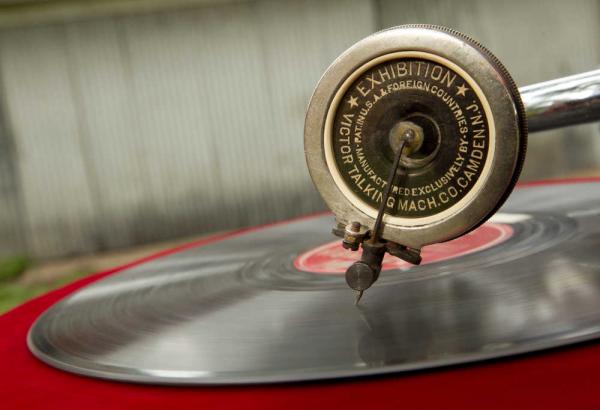
The sounds of Woodstock or Monterey or even the gentle tunes of the bobbysock days all have a certain twang that sends us to a different time. What is most amazing about this sensory input is that even if we weren’t alive to see the concerts of Elvis Presley or a young Billie Holiday, our imagination (or perhaps some innate similar sense) makes it almost as clear as day what that must have been like. We can argue that music sends us somewhere, but what kind of research can be done? Well, for one thing, there is something about oldies but goodies that entices people worldwide! Just the other day, I found out that Canada has a Vintage Phonograph Society for all those who own a well-cared for phonograph (yes, with the cornucopia horn thingies). The whole concept of producing vinyl records, in fact, has become a thing among modern musicians like Coldplay and others as well. (Urban Outfitters and record outlets often have these in stock). There is something  far more gratifying about records than other forms of computerized soundwaves anyway.

Music allows us to experience things from every time period and all stretches of the emotional spectrum. It’s no wonder that it means so much to revivalists and psychologists alike. So I leave you here, dearest readers, to meet Manny, my right-hand man in musical and antiquated antics. I promise he will broaden your musical horizons and lift your spirits; he’s notoriously good at that for me too!

Posted in The Publications

The Modern Levittowns

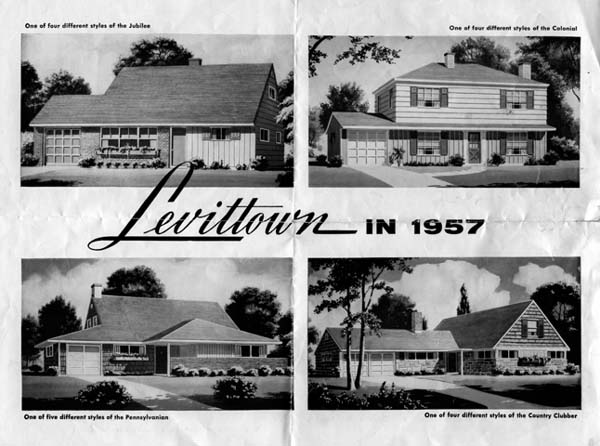
So I get back from my history lecture and go straight to Google Maps. We were learning about the phenomenon of Levittowns and why they were so significant in mid-century America. Naturally, I’m weird and compelled to see how Levittown PA matches up with how it was envisioned by Levit back in the day…. How adorable these little casas are! There is just enough space to be cozy! But the advertisements and propaganda, the articles and posters… they all suggest there’s some high level of conformity here. The stereotypes of housewives, the GI Bill, the social fears and high de facto expectations all haunt the area even today through my innocent computer screen. How can we allow this to still shape our idea of vintage living…?
It honestly bothers me that this is considered scholarly. For you all, I’d like to point out some themes that we still live by today, which extend well past the township borders of 1957 Levittown.

One of the most profuse comparisons I can see is the frequency of larger homes and the expansion of ‘mcmansion’ developments rising all over the country’s suburbias. Each house on a given street still has expectations to be met on the foundation of appearance, which sometimes replicates the ‘cookie cutter’ feel that emerged around the 1950’s Levittowns. Of course, there is a notion of postmodern architecture that came to fruition through the Levit movement. At the time that Levittowns were being completed, a song called “Little Boxes” was published, which lyrically references the idea of these quaint little cottages. If they were little boxes, then are today’s houses jst bigger boxes? Asymmetry, detail, and craftsmanship is becoming more and more minimal, and more pieces are becoming scarily prefabricated, (remind you of Edgewater, New Jersey?) With these pristine homes, there is also expectation to keep them as lovely as they were when bought new. A sense of formality exists especially in areas that are known to be aesthetically, visually appealing: De facto rules clearly exist to maintain a location’s reputation.

It may sound stupid or overstated to some, but it really breeds into other conflicts of present interest like gender-specific expectations and even workplace inequalities. The community mindset sinks in and spreads like wildfire. Of course, we counterbalance these negative, petty, and often dramatic nonsense with new concepts to mesh with old traditions. How we can spend our time today makes us extremely efficient and capable of incredible social change. Instead of sitting on our technology devices all the time, there is time for us to create landscape architecture, produce inventions to better our lives, cook gourmet meals with the help of media and recipes, learn new skills and create things, and even learn to drive stick shift or renovate our homes (if you’re feeling ambitious). Becoming engaged in our communities as they are built to be will mold this world into what we want it to be. Generativity is what the vintage morale advocates. So spread the love, the values, and the happiness to your neighbors. In the end, all we have is each other, whether we had a ‘little box’ or a bigger box.

Posted in The Publications

Layla and the Other Memorable Automobiles

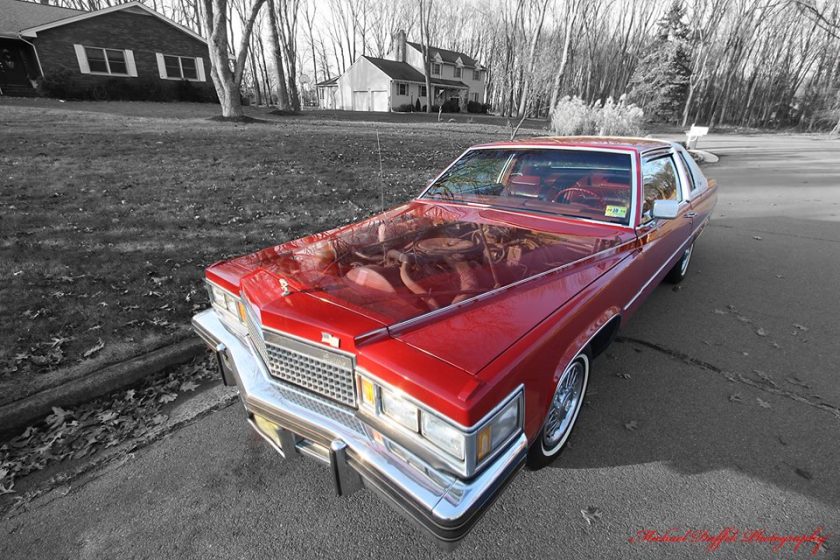
She was red, shiny, and ridiculous. She was loud, large, and fun. Layla was my dear friend’s 1979 Cadillac DeVille. And she was our ride for countless cruises, countless cruise nights on Fridays in Somerville, and some shenanigans here and again. She lived a good life while under the proud ownership of my friend Michael Duffek, but she alas had more ailments than could be addressed. Under different owners though, she’s still running. There’s something that makes these steel stallions outlast their modern fiberglass counterparts.

Michael is still highly active in the world of classic automotive, and I decided to take care to get insight into that subdivision of revival culture at the very beginning of Cruise Season. Check out his work here! https://www.facebook.com/MichaelDuffekAutomotivePhotography?fref=ts Having the Somerville Cruise season start up on Memorial Day weekend made this feel like the best possible time for this publication. Since 2012, I have been well-cultured in the world of classic automobiles, with all courtesy to Mr. Duffek. But what makes these particular metal beasts so appealing even decades, (or a century!) after their heydays? I turned to my dear friend for all the answers and insight to the Cruiser culture.

Foremost, I should denote that he is an avid fan of American-made classics. The foreign beauties are also prevalent, but let’s focus on some good ol’ Americana for argument’s sake. Besides, sociologically, the history and vintage concepts I present are limited to the bias of American history, since this is the history I grew up learning as a lifelong citizen of the States. Anyways…

Mr. Duffek articulates that a strong pressure to invest in a classic auto is to support the industry, (even though some of them no longer exist, like Studebaker, Oldsmobile, Pontiac, and Packard). It becomes your mission to bring glory and awe to your brand, even if it is not well-known. The economy may not be as sterling as it has been in yesteryears, but classic autos are a way of paying homage to the hard work of the assembly line. All are used by this day and age, and the maintenance is high, but you eliminate the large and fast-paced dealerships.

By buying into a project piece, as I’ve come to call most antiques needing TLC, you participate in a journey. You’re compelled to learn about the car, restore its original features, track its history, and eventually you end up treating it like your pride and joy. But, taking intricate care of our treasures reflects the kind of person in a retro lifestyle. The more obvious notion of a retro set of wheels concerns the building materials. Instead of driving a brand new Cadillac whose main pieces consist of plastic and fiberglass, the older grandfathers to the same model offer steel and more space.

“It’s about the connection between the person and the car. What makes it desirable to the person?” He discusses with me what a connection really is. The principle of the feeling is built on a desire to be different, to stand out in a positive light. He explains that the buyer and caretaker of these classics needs to be impacted by the car’s influence and history is in order to appreciate it thoroughly. With this passion ignited, there is definitely a subculture of cruising within the american culture, especially with the ever-constant rise of interest in antique cars. This interest dates back to 1952, as featured in a magazine “Popular Science”. Let’s even take it further and acknowledge the Youtube hit series “Jay Leno’s Garage” or the recently discontinued “Top Gear”; both of which fuel the interest we all share for the classics. The fascination, fueled reciprocally by media and passed between generations, continues to support revivalism as a whole.

There is something compelling about the entire experience of a Cruise night, much like that of Layla’s heydays. How can one miss out on the antiquated antics this Cruise season?

Posted in The Publications

The Media Hype!!!

In the last few weeks of being able to think about more than just school, I’m starting to notice media attention to the entire concept of revivalism. Some of it, admittedly, focuses on extreme movements for art deco and mid-century motifs. The demand is rising for values and styles of the eras past. Do we have a collective unconscious desire for sophistication and attention to detail found in other cohorts? I’d like to think so.

The other night, to my bewilderment, I watched the premier for Retro Wives on TLC. While this is a case of women taking on very committed, highly devoted roles of mid-century housewives. It was amazing, and sometimes relatable in their reasoning. One of the featured women disclosed that her ‘greatest sense of pride’ comes from wearing her mother’s clothing or stepping back and reflecting on a well-prepared, well-dressed table on a Sunday night. They discuss ideas like taking care of the little things, managing a home, and looking simply marvelous. Of course, we must approach topics about vintage life with a grain of salt, so to speak. Even then, people were able to be dramatic and superficial, and some things never change. In order to be the generation of pleasant social interactions, perhaps we can exclude the drama and hold onto the thoughtfulness and attentiveness.

Another spike in the media has struck me as fascinating, Check out this commercial for detergent: https://www.youtube.com/watch?v=XSdHyNxBxuE Now, detergent commercials have been around for about 90 years with the implement of sponsorship on the radio and symbolize the historically stereotyped ‘women’s work’. But what’s important here is the music. Play it over if you missed the tune. In 1955, this song was recorded by Bill Haley and His Comets… https://www.youtube.com/watch?v=XSdHyNxBxuE It simply must ring a bell now. Just as a side-note, the bassist in this group is delicious in his skills and showmanship. Pop culture is slowly inoculating us with retro messages, in essence. Which isn’t a bad thing, it’s rather swell.

Need more evidence of media and pop culture assimilating into revivalism? I promise its not just another trend or phase. Rock and Roll was always here to stay. It’s just been waiting for the right moment. Although retro and vintage does not always reference the middle of the century, another TV show, Astronaut Wives Club based on a collection of true narratives, will be airing soon, and there will be a Facebook conversation about this for both viewers and non-viewers.

So even if we were to stray farther back in time to the Swing Era, the Roarin’ 20’s, we still can identify the influence of this culture on today’s media. Bessie, a film that follows the tumultuous life of legendary blues singer, Bessie Smith, was just released about 3 weeks ago. There has been some thought concerning a possible link between the spike in 1920’s revivalism during the pre-release of The Great Gastby and the rise of this film documentary. While there is no particular way to define this connection, the suggestion isn’t half bad. The sound, which is most notably heard in the works of Scott Bradlee and The Postmodern Jukebox, has been growing in momentum in culture as well, and as promoted the consistency of our interest in the Era of Swing, Art Deco, and the first classy partygoing decade.

There is a large part of me that wonders how our modern world will adapt these ideas into one cohesive influence. These reflections on decades past are becoming more and more pronounced, but with so many different years impacting this overall revivalist movement, are we going to be as diverse as the years themselves? What a fascinating conglomerate we could be!

Posted in The Publications

Capturing Time

http://jmcs.deviantart.com/ This simple web address is home to the lovely works of a seasoned photographer… he also happens to be a dear friend. After many scenic outings and lots of pleasant conversation, I’ve compiled a short history of photography and its earlier contents. One of the claims that Mr. Shulack describes to me often is the notions of modern photography and the roles that film and print have played in years past.

He approached the topic enthusiastically, probably because he’s avid about his craft, and gathered several pieces of medium to illustrate to me his every point. All the senses are captured in pictures, Joseph explains, and that taking pictures is an experience that engages the subject and the photographer alike. “Things in the 1830’s-1850’s set up how, and why they [photography] progressed this way”

In the 1800s, photography was in its infancy, and often performed with the help of chemists or pharmacists because of the harshness of the materials used to develop pictures (daguerreotype) and the specialised preparations needed. Over time, we noticed a change in the pace that introduced glass plates, most famously found in the Bonnie & Clyde Museum, and also featured in an episode of ‘American Pickers’.  As with any other technology, it’s original form (referred to as “Wet Plates”) was rudimentary and obtrusive.  With advances in chemistry, commercial “dry chemical” glass plate came about. These were exceptionally successful because they introduced both a greater convenience to the photographer, as well as much improved separation of grey tones; the improvement trend continued this way for a bit.

Consumer friendliness in the photography industry, Joseph says, was brought on by two major things: “cardboard and roll film, and so was born the kit for the Kodak Brownie #1”. When the consumer was finished with the roll of film, they sent it to the Kodak processing center to be developed and a replacement sent back. The ‘lost generation’ between 1900 and World War 1 signaled a rise in photography while painting declined, which indicated an “intermission in home art forms”, Shulack explains, “It’s called ‘lost generation’ because so few depictions of children were made at this time compared to prior years”. He continues to explain that, “another huge event that made photography viable to the public was technically an accident” I had to laugh because by this time I felt like I was in a specialized art history class, surrounded by rather attractive older cameras and stunning pieces of equipment that I’ve never even seen before. He spoke of Oskar Barnack, a German hiker and engineer who contracted chronic asthma later in life, and as a result couldn’t carry heavy equipment on his treks.  Mr Barnack ended up kitbashing together a camera that used conventional cinema film as still film (later known as the 35mm format).  While this was not a popular format upon its conception (mostly the place of amateur newsmen and shoestring-budget street photographers), it would become so later.  We then jumped to the 1960’s, an era where colorful pastels and interesting prints made subjects turn into pop art all over. Joseph sipped his tea and said simply, “a 35mm film camera was what made the camera accessible to millions globally”, and he sniffled his head-cold sniffle again.

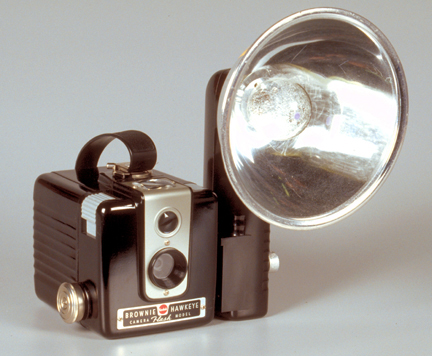
Sitting next to me on my right was the loveliest piece in the most mint condition I’d ever seen. While bickering about his stuffed up nose intermittently, I flirted heavily with his box camera, a Kodak Brownie Hawkeye. He took to my unabashed admiration quickly and explained that medium-format box  cameras were popular for domestic use and became excessively desirable in the market, with its peak during the 50’s. Across from me, also grappling with my attention from the box camera was a mamiya rb67, affectionately ‘the anchor’ for being ridiculously heavy. Its significance is in its manual design even in modern manufacturing, making it the most traditionalist piece of photographer’s tools there is (short of a view camera).

After the brief history lesson and 4/5 a cup of tea, I asked one simple question, “What concepts can we derive from photography then that can revive this form of art presently?”. He sat back. Sipped more tea. Breathed a heavy sigh, and gave me a look. I sat there with my fingers ready to type out something profound and quote-able, my glasses sliding back down my nose. In an instant, I realized where I was, what I looked like, why I’m typing this. Another circle skirt tickled my shins under the table. I smiled, and he answered, “previsualization: one thing that is a huge problem with photography nowadays is digital itself”. The problem is simple; it is cost effective and the cost on photography is immeasurable. “With film, you have to understand your shot before you took it, and it cost you money per shot. [Digital photography] has devalued worth of finished images, because all digital [pictures] can be deleted, and it all takes less effort, time, and skill to capture something beautiful.”

“What my main problem is, you could say, its with the photograph being seen as something that, if taken enough of, you’ll eventually get something of value. no other form of art is like that. if you give the same monkey a paintbrush and tell him to paint a million pictures instead of taking a million photographs, he will not master pointillism or create works such as those by Rembrandt. In the past, the monkey would have never been able to create photographs like those of Galen Rowell or Alfred Steigletz.  However, this could mean a new dawn for photography as a primarily communicative tool with artistic merit, rather than an equally communicative and artistic tool as it was thought of in years past.  You never know what’s lurking around the corner, and I can see no better outcome.”

I think that Joseph has a lovely set of points here and is, within himself, rather traditionalist. The simple, effortful craftsmanship is clearly valuable to him and his own work reflects careful attention to detail. I should probably say also that each of these unique cameras offer a different image that captures a moment in time. Each perspective is unique to itself and Joseph is a leader in emphasizing their contributions to how we perceive the world through film images. It was a pleasure to take care of my first interview with such a dear friend, and I look forward to more retro road trips in his company, and with the company of his many lenses to capture time. If you can make time can stand still for even the smallest instant, there is so much we can learn from it.

Posted in The Publications

Skirts aren’t Submissive

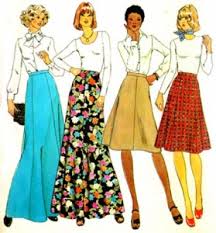
When a girl wears a skirt, she risks a lot. She takes her femininity in strides, casts aside the concerns of being ‘provocative’, and welcomes the fluttery garment that history itself denotes as hers. She takes up confidence and welcomes the unique sophistication that pants just don’t offer. Much like the prior RR post about aprons having a controversial past attached, skirts too, (up until recently), have been subject to bias and question.

When did woman have to become so rigid and tough to handle the life around them? What makes a lady in a long flowing skirt any lesser than a lady in blue jeans? Frankly, either one in this day and age can kick someone’s ass equally nicely. A skirt does not mean that a woman or girl submits herself to being dainty or objectified. That skirt can have a train the length of her hair, or it can be as skin-tight and short as all hell, but regardless, it doesn’t make her provoke anything. It, like anything else a human does, makes her self-expressive. Arguably, wearing clothing at all is just a way to turn a person into self-made expressionism. Since the early 1920s, in conjunction with the fad of self-help booklets and social change, the image of woman has been molded to fascinate, at the bias of the author.

Just the other night, I had the simple luxury of sitting in the psychology aisle of Barnes & Noble. In reading, there was a notion something along the lines of “how can people know a woman is clever and fascinating unless she looks like that?” Well, the cover of a book (all pun intended), shouldn’t be used to judge the book itself, as the adage goes. Some of the finest, most intellectually achieved women choose to ‘dress down’, and some of the strongest, most independent women choose to boast a skirt. Today’s world tells us we have to be strong, fend for ourselves, and do so in good competition to male counterparts and other females equally. A skirt is debatable, depending on who you talk to. They’re either perceived as cute or ‘ew’. Perhaps not as taboo as the apron was, a skirt still yields inhibitions for several reasons, including the old notion of ‘picturesque women’.

I’ll start by saying that skirt-wearers do not seek to conform to the idea of a ‘perfect woman’. Magazines and celebrities and media can say whatever they want, but persuasion doesn’t always decide for the person. Next, a skirt is worn in free spirit and spits in the face of provocation. We don’t identify with those who believe that pantslessness equates with unwanted attention. We do not fear the perceived consequences. The only goal of a skirt is to be comfortable and beautiful in the eyes of the wearer. Finally, whose to say that a woman in a pastel skirt can’t stand tall and confident as one in black jeans and a denim jacket? It seems like we are most susceptible to assault in skirts, but there is no way to judge a book by its cover (restated for dramatic effect). A skirt is truly an essential piece to any woman’s wardrobe. If I’ve learned anything about wearing flamboyant, flouncy bottom-wear, its that this is the time they’re able to shine again and that they only express one universal thing: we’re pleased to be females and take some interest in the history of our subspecies. Furthermore, as the title of this article suggests, skirts don’t ever indicate submission. They may have historically symbolized the stay-at-home housewife, but today they only serve as an outward expression of inner beauty.

* * * * *

Now, as for my guy friends, who are also many and plenty, they don’t seem to treat a skirt any differently. Just as the apron is in its redemption, it seems that the skirt is equally a post-hoc taboo of generations ago. One unnamed contributor suggests that “Its her behavior that really makes a guy interested, the style comes second… I mean, most women have a good sense of what makes them look great anyway”. While the response is not unanimous, this is the basic scope of what the male population contributes to this discussion. Arguably, much like how we females enjoy seeing a well-dressed gentleman, they’re not opposed to reciprocal fancifulness from their counterparts. I was delighted to hear that another masculine source was pensive on the topic, “Guys can choose to dress up or down and no one makes a fuss, so what’s the difference for girls? No problems here with a pretty lady!” It’s sometimes hard not to laugh in chatting with all my sources, especially when I’m wearing a massive circle skirt myself. Conclusively, the well-dressed person is one whose attention to detail does not go unnoticed.

Skirts, my dear readers, are not a taboo piece, but a historically significant must-have for every closet, and ultimately the greatest symbol of happiness a woman can wear on the outside.

Much Love, ~Harpie Lyn