Posted in The Publications

Christmas Nostalgia for Craft Stores

In my recent pilgrimage to one of the happiest places I can think of (Michaels Craft Store), I stumbled upon perhaps one of the greatest treasure troves of retro-inspired home decor. Aptly titled the Jingle Jolly Way collection, (primarily manufactured by Ashland decoratives), this Michael’s exclusive offers a delicate nostalgia for a midcentury Christmas experience. Pair these home accents with a warm batch of cookies, a flour-dusted apron, some family, and a good gallon of egg nog by the fire and you’re sure to have the most remarkable retro holiday ever. Some of our favorites are:


Still can’t get enough? Retro inspiration for the season is palpable across the market. Vermont Coutry Store and similar online retailers alike have found success in sales of classic ceramic tabletop trees such as these: Nostalgic Trees!

It seems that thematically, the recreations of the classics are made with the same materials with very few changes to the overall product. For instance, the ceramic trees are still made of ceramic as opposed to a newer or synthetic contemporary, which is considerably authentic. For the Jingle Jolly Way collection, these are modeled after color schemes popular from midcentury culture, while opting to use newer materials. Turquoise and red pay homage to the classic red and green of the holiday season while tributing some pastels back to the 1950s.

We are delighted to bring the retro back into the traditions of christmas (and all the other holidays too!)

It is such a busy and festive time of year no matter what our darling readers celebrate. But from us to you, may your days be merry and bright!

Posted in The Publications

Typewriters as Teachers

Click click click click click click…. Ding!

I often credit my mom with teaching me how to type quickly and accurately. The truth is, while my mom’s expertise was the foundation for my computer literacy, I think that acquiring a Smith-Corona was the impetus for me to type smarter. Sure, speed is excellent, especially in our fast-paced world; but no one talks about accuracy. Almost every software program on modern computers includes spellcheck and/or autocorrect features. So, why bother learning perfection if a program does it for you? …Are we really evolving into a half-assed population?

I will be bold enough to suggest that all young people should learn to type on an old, loud, rickety typewriter to learn a skill rather than muscle memory alone. Keyboards aren’t fit for children for several reasons: they aren’t posture-sensitive, peak no curiosity, and there’s not emphasis on the human touch when using a computer. Shall we dig deeper, darlings?

Unless keyboards and computer desks are specially prepared with wrist rests, a proportionate chair, and other fixings, children are bound to develop a slouch or scoliosis (like Harpie, who is critically conscious of her sitting position right now). No school is going to spend extra money on non-necessities, and likely would instead blame scoliosis on desks and lack of activity. With typewriters, they are far more elevated, which defaults the children to sit up straight to see what they’re doing.

Which brings another point into perspective: the little learners will want to engage with the odd-shaped contraption because this isn’t your boring-ass MacBook (sorry Manny Dylan, but your computer doesn’t ding after I type each line). It makes new sounds, looks different, and produces lettering that is standard (much like that fancy Times New Roman in 12-point font) but unique from a printer’s methods.

Last on my venting list for the shameless promotion of typewriters is just that! Feeding a printer and seeing your work on a screen is completely devoid of human contact! Writing is an art, an expression, and most importantly, it is a form of contact. I’ll bet you’d be far more thrilled with someone who took care enough to use a typewriter to send a letter than someone who typed and printed a few messages on your letterhead. It simply has deeper meaning. Children will learn that. Over time, they will notice and learn to appreciate it. The revival of the writing bug will extend itself past the typewriters and expand to the boosting of cultural and heritage morale.

All just because you (collectively) taught those children to type first on a typewriter. It’s cool. It’s nifty. Typewriters can be teachers. Embrace the clickety clackety beasts!

Click Here for a Typewriter Testimonial 

Thanks to the People’s Store in Lambertville NJ for their photogenic typewriters! I’m still swooning over the Remingtons.

Posted in The Publications

The Trials of Doris: What Now?

There was a lot of discomfort in the small group of people congregated on the steps to the lost mansion at Duke Farms today. I half anticipated to see tourists thrilled at the sight of newly-opened acres, but instead I saw some empathy of the experience settle in. Faces of disappointed and mourning visitors looked toward me, half confused and half desperate for the answers to the absurdity beneath our feet.

It was gone. There was nothing quite the same since then, and I admit it was some relief to know I wasn’t the only one feeling this way. Despite everything, there was some glimmer of hope, some indications that the ownership was ashamed of their actions, and some sense of direction to protect what remained.

Today I share with you Operation ORCHID, the loosely-knit organization advocating for the accurate and fullest amount of information on the Duke history, and encouraging change of methods at the property’s executive level. As one of the cornerstones of our mission, Op ORCHID wants to acknowledge the intricate level of horticultural design preserved in the meditation gardens area just southwest of the mansion’s memorial, but we would also like to identify that there are no paths in the area where the house stood, meaning that there was literally nothing that the mansion was in the way of.

Of particular interest is that the Duke Farms social media outlets don’t seem to share information on the reopening of these acres. Why, if after more than two years of arguing that their decision to demolish was the correct thing to do, would the foundation forget to publicize one of their biggest ‘accomplishments’? Maybe after seeing the landscape without the house, someone realized that it wasn’t what they were hoping for. It’s a very sad reminder, but that’s not something we can put back and get a ‘re-do’ on. Another fascinating component of today’s wandering brings us back to the Duke Gadens greenhouse structure. It seems as though its ancillary structure, the visitor’s center (which now houses an empty vending machine and bathrooms), has been liquidated of its files, records, furnishings, and any other affects that suggested it was used in recent years. These empty shelves can be found through the windows of the visitor’s center, which is in sharp contrast to the previous observations made of a room heavily stocked full of papers and boxes, office furnishings and file cabinets.

We took some photos of the somber scene as time stands still at the Duke Estate. Want to know more about what you can do to promote preservation at this historic paradise? We are available 24/7 now by email at theretrorevivalist@gmail.com. Start holding these exectives accountable for the extreme display of demolition and neglect. There are several fountains, structures, statues, and a series of greenhouses from Duke Gardens that still need to be cared for, not forgotten.


Posted in The Publications

The Lawsuit of McMansion Hell

mcmansionhell.com/ (Click for direct link): this amazing little site normalizes the conversation about oversized, gluttonous houses that lack most classical components of good architecture. As retro culture advocates, it is so valuable for us to recognize that a huge house for the everyday resident doesn’t make a lot of sense. People don’t actually need 4,000 square feet of living space to be comfortable. Back in postwar America (late 40s through the 50s), the tax percent on the wealthiest citizens was 91% (americansfortaxfairness.org) and even then, the middle class lived in neither squalor nor excess.  We aren’t here to talk heavy politics, but this is a key reason why American society functioned so differently than today. So let’s dig:

Retro is stereotypically matched with the midcentury culture of America. Given this, it makes sense that those who identify with this theme of reviving the good stuff would find large, 16-bedroom houses to be a bit… excessive. But it’s not the sheer size that frustrates us. It is the lack of real craftsmanship and old-world class. McMansion Hell (operated by Kate Wagner) identifies with this concept of lackluster architectural mishmash and thrills at the opportunity to poke fun at the curious components of these residential beasts.

I’m sure some of you are asking, “Didn’t the RRBlog stand in solidarity against the demolition of a huge house?” We are glad you stayed curious! Yes, we did and we still do. The difference is in the decades; unlike historic houses or the careful craftsmanship of older homes, the houses featured on Wagner’s website are devoid of authentic, classical character or features that are made like they used to be. These pompous structures are the subject of her satire often because of the seemingly shoddy replicas of features produced after the 1980s! No carved wood or parquet flooring here!

For several weeks, Wagner faced Zillow, the booming online business that features sales and rentals of all sorts fo structures for individuals to search through. Although the multi-billion dollar company owns none of the pictures used on her site, Zillow is outraged at the satire. This is an amazing story of the people winning their cases, however. At the end of the experience, McMansionHell was up and running again, but with some compromises. The site, although active and essentially winning their lawsuit by default when Zillow dropped their charges, has had some formatting changes and had to rescind several dozen posts from the previous website versions.

Of course, we are grateful that Kate’s story is a successful one and the Retro Revival will continue to encourage people like her for promoting a healthier sense of craftsmanship, pride in one’s work, and cultural artistry of all kinds!

https://americansfortaxfairness.org/tax-fairness-briefing-booklet/fact-sheet-taxing-wealthy-americans/

http://www.seattletimes.com/business/real-estate/zillow-vs-mcmansion-hell-seattle-company-not-backing-off-fight-with-blog-despite-pr-fiasco/

Posted in The Publications

The Rock Flock! Revitalizing Lawn Flamingoes

Two weekends ago at the Retro Revival, our writers congregated in Hillsborough to discuss a local phenomenon aimed at bringing members of the community closer together. The concept, ‘Hillsborough Rocks!’ is an ongoing state of hide and seek played by colorfully decorated rocks placed around public areas of the town. It’s a playful little reminder that we all live and create art in this darling little corner of the world. This theme is revived from a previous concept though: we compared the rocks to a good old-fashioned lawn flamingo flock!

Hillsborough Rocks isn’t the only arts-n-craftsy community glue of its kind- many towns in the locality and across the country are participating. It’s an odd little pleasantry, really. Much like the happy staples of the midcentury’s residential landscapes, these flamingoes were placed around town to promote congregations, emphasize togetherness, and remind everyone of the symbol of the flamingo itself: don’t worry, be happy. The best way to keep track of these artfully decorated stones is to watch on Facebook pages pertinent to your town. It’s easy to begin and more fun to watch others get started, pick up a paintbrush, and colorize the township, one rock at a time.

It was quite an adventure into the arts for us two, but we are grateful for the results. These feathery fancies aren’t quite so feathery- Among them are tiny silhouettes, minimalist styles, and inverted colors, all flocking together for a grand total of 8 unique flamingo-inspired designs. Can you find all the members of the rock flock? If you can find one of our Hillsborough rocks, be sure to post a photo of it on our Facebook page at Facebook.com/retrorevivalist before you re-hide it!

Stay Curious and thanks for playing!

Posted in The Publications

Exciting news, and a new feature you may notice!

We at the Retro Revival are very excited to announce that we are officially Amazon Associates, so the link provided below if used will support the blog do any purchases you our lovely readers make using Amazon through this link. Using this link does not add to your cart total, and helps us to write and create more content! 

Our Amazon Associates link is; http://amzn.to/2xCsgC6 

Posted in The Publications

The Antiquated Antics Jello Challenge with InTheVintageKitchen.com

From the Antiquated Antics summer series at RRBlog, we met and quickly befriended our retro colleague, Katherine: the culinary genius behind https://inthevintagekitchen.com/  (click for link). Her work spreads through the pages of dozens of cookbooks from kitchens past. In hopes of bringing us closer to the eclectic nature of the midcentury mold of jello, Miss Katherine has joined forces with RetroRevival Blog and other friends to bring 3 jello recipes back into the spotlight this summer. It is up to the bloggers to decide which of the three are our favorites, how we would change the recipe to fit into revivalist-modern, and of course, to share the challenge with our readers.

Jello, or gelatin molds, were the immensely popularized mealtime favorites of the iconic 1950s housewives. While we will be having a series about their feminism later on, let’s focus on the jiggly wonders that are served for dinner, lunch, and then dessert. Knox brand gelatin is the star of this show! The unique sculptures of food became a star in the dining room for two major reasons: gelatin molds didn’t require the use of the oven in the heat of the summer, meaning that the savvy housewife saved money and energy. The other simple reason these dishes flourished was because of aesthetic appeal. Although today they are looked upon as a culinary oddity, they were once considered a sign of luxury and tasteful articulation in the home. Another big score of points for the wife who could create these eyefuls.

In preparing these retro dishes, we bloggers learned two things about an authentic vintage kitchen. First, don’t be afraid of trying new things. While it seems weird, foreign, and sometimes downright gross, the truth is that different can be delicious! Finally,

So today, we decided to team up with Katherine to see whose gelatin recipes (all derived from 1955 recipe books) came out good, what we would change, and more! These are our results: https://inthevintagekitchen.com/2017/08/25/three-recipes-three-kitchens-six-cooks-its-the-wiggly-jiggly-vintage-gelatin-cooking-challenge/

Check us both out on Facebook:

Facebook.com/retrorevivalist

Facebook.com.inthevintagekitchen

Posted in The Publications

Antiquated Antics: Herb Growing!

When I started gardening, it was for the simple fact that I love flowers. The family appreciates the view during peak seasons, too. Winter in the Harpie house was filled with reading up on herbs and spices and all sorts of interesting notions after a fellow gardener and camera extraordinaire, JMCS, gifted me the book of The Medicine Wheel Garden. This became my impetus for finding the intersection between perennial and herbal gardening.

How can this tie into retro culture? Hoowee what a story! It wasn’t until the economic boom of the 1950s that major antibiotics were established and distributed for all the common ailments of the population. Prior to these big-name pharmaceuticals, many people relied on ancient medicines to care for themselves and their families. Much of what we know about herbal healers comes from ancient Chinese and Native American derivations. For instance, cardinal flower has been heralded for its qualities similar to nicotine, and is used to this day in substances like Nicorette gum to help wean smokers of their habits. I figure if these practices were commonplace before the pharma-takeover, there’s definitely a place for it in today’s culture. Let’s help simplify the way we care for ourselves from the roots: literally!

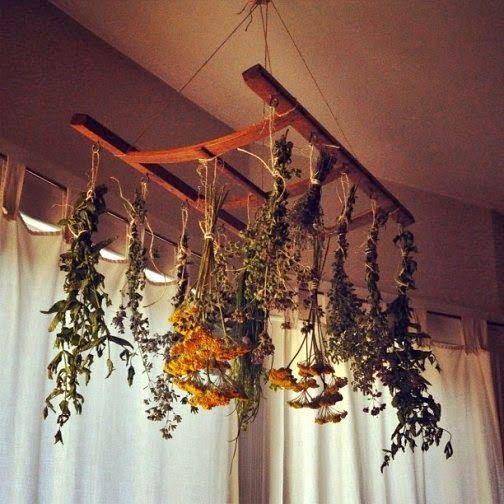
The first step in herb growing and use is educating yourself. As a general precaution, it is very important to know your own allergies as well as those who you plan on sharing your concoctions with. Read up on the possible side effects of plants, how to use them effectively and safely, and establish your plan from there. The obvious next step is to plant and take care of whatever you want to grow. Sometimes it takes buying extra bags of soil or learning the preferences of the plants, but they’ll sprout. For quicker results from seeds, consider residential greenhouse accommodations- there are whole buildings to tabletop structures to fit your preferences. Drying and recipes are probably the most vintage concept out of the whole lot of herb growing. It’s also rather challenging for me- but easy to catch on. Use a cotton cloth to lay plants on to dry. Go for the crispy but not disintegrating consistency. Some people opt for drying racks like the one pictured above, which is probably easier for flowering plants. They often don’t dry cleanly otherwise.

While it is not usual for us to feature something that is this antiquated, we wanted to make an effort to give all facets of yesteryears- even the antiques (over 50 years old) and ancient traditions- a chance to find rightful spotlight in today’s world.

Some of our favorites are yarrow- which was used by Native Americans for all skin ailments from eczema to repelling mosquitos; Echinacea- which has been heralded for generations as a remedy for colds, flus, and strep throats; and

The bottom line? A vintage life can free you from big pharmaceuticals in exchange for natural remedies and home-grown goodness. Cheers to a healthy life, darlings!

https://www.chicagobotanic.org/plantinfo/herbal_history

Posted in The Publications

Historic Commissions: A Model for Excellence

The RRBlog team was in Plainfield last month to observe how a historic preservation commission handles administration of awards to its community members. Instead, we got much, much more.

In addition to the awards being given out to Nancy Piwowar and M&M Investors that lovely Tuesday night, we got to observe how the commission handled a couple whose house was historically designated but wanted modifications. This is what we found:

  1. The entire commission was not situated in a courtroom, but a ‘library’; this library was essentially an immaculately-preserved conference room with red carpet and a nice, long wooden table with chairs to match. The committeemembers would all sit down at the table and the presenting couple stood at the head with their materials to discuss. This gave the floor to the speakers without and superiority complex of the committeemembers being seated in a formal courtroom setting.
  2. The ordinance mattered! These individuals not only cited their ordinances for preserved houses, but it appeared as if this was memorized and the individuals could offer knowledge to the couple that presented in a way that encouraged and informed the homeowners.
  3. This commission was diverse. There were males and females of all different cultural backgrounds and cohorts; this allows for ideas to be circulated and to prevent ‘stasis’ from occuring within the chamber. It is always vital to avoid being stuck in a cycle of sameness so that new methods and meaningful dialogue can be reached.
  4. During the meeting, there was discussion among the members about different components of the couple’s modifications. Discussion is the vehicle for compromise and efficient outcomes that meet the needs of both the homeowner and the chamber.
  5. Most impressively, there was human spirit. Not only was the conversation cordial and oriented toward the homeowners, but there was encouragement and humor. The best quote all night was when the chairman expressed concern for the greater issue of the case citing that “We have a very strict anti-discrimination policy here. You (the homeowner) have mentioned that there is not one, but three man doors that you will be changing or modifying. We have to ask that you refer to them as people doors instead.” Well played, Plainfield. We all smiled ear-to-ear

The reason that I bring all this to the attention of our readers is that it was a surprisingly heart-wrenching experience. Sometimes it is easy to take advantage of these kindnesses; not every town has a cordial interactions with their HPC. Sadly, not everyone has an approachable commission. Some towns are crippling themselves with stasis in their commissions and gridlock themselves from real community engagement while others do this intentionally for a sense of control over their residents. Plainfield, if you are reading this, you are a model for excellence in our books for what a preservation commission should look like. We hope you are CONTAGIOUS!!!

Posted in The Publications

RRBlog’s Official 100th Post!

What a celebration to be had for the staff and readers of Retro Revival Blog! This post is our 100th! In just two short years, we have come so far in our writing styles and content, experiences, and dedication to the retro community– Which is ever expanding!

We are so humbled and excited to say thank you to our readers as we take a moment to reflect on all the amazing things that RRBlog has given us over the last two years. You’re all so amazing!

We started with an apron, collected a best friend, ideas, adventures, and a box camera, and then embarked on the following of the trials of Doris- one of our most popular sections. Since then, we’ve made some amazing blogger friends, historian friends, and met some of the retro culture’s greatest advocates. Now that we’ve made it all this way, let’s talk about what’s coming up and what’s continuing to stay swell and dapper!

The Trials of Doris, as well as all our regularly scheduled columns, will continue as expected. Clicks Pics has been scaled down to a yearly review because of the rising costs of developing manual film. Some new things to look forward to is our collaborations with remarkably retro sites like  https://inthevintagekitchen.com/  and https://www.retronaut.com/ as well as sponsorship from some generous darlings in the business!

If you have something you’d like RRBlog to look into, write about, or bring to the internet for a good talk over tea and biscuits, let us know in the comments section or on our facebook page at Facebook.com/RetroRevivalist or on Twitter @RetroRevivalist

From our hearts to you, THANK YOU!